How Solfeggio Journey is built: layered binaural beats from 4 to 40 Hz on carriers from 69 to 971 Hz, session by session, with the research behind the method and an honest summary of the evidence.
Every session is a layered binaural program: several tone pairs, one tone of each pair per ear, over a soft noise bed. The numbers below come straight from the session designs.
The course in numbers
Beats from 4 to 40 Hz, covering the theta, alpha, beta, gamma bands.
Carrier tones from 69 to 971 Hz.
Up to 4 tone pairs sound at once.
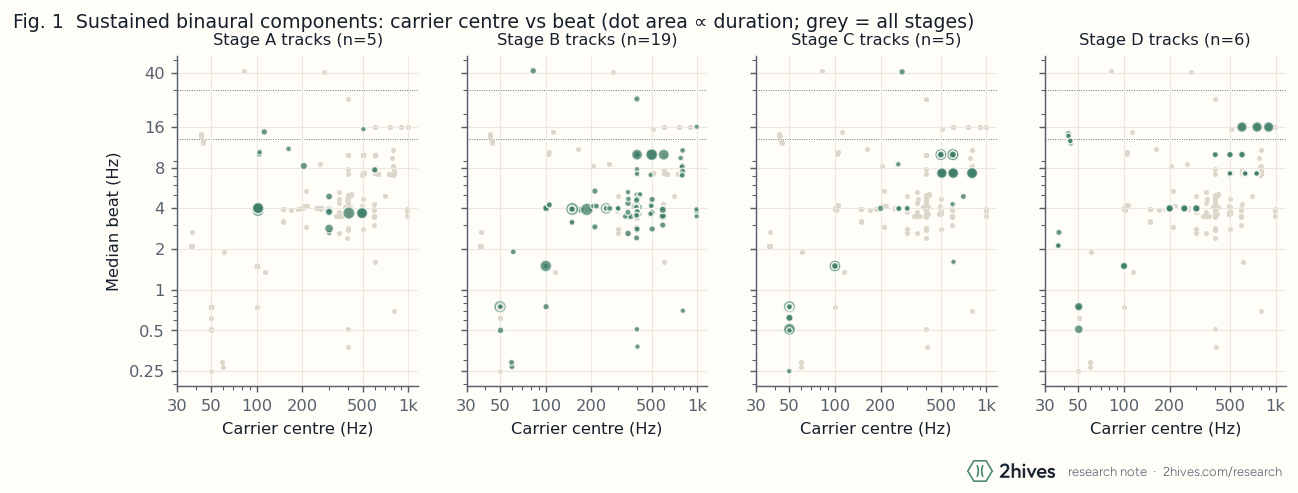
Slower beats sit on lower carriers in 84 of 90 pair comparisons, the ordering measured in the reference set.
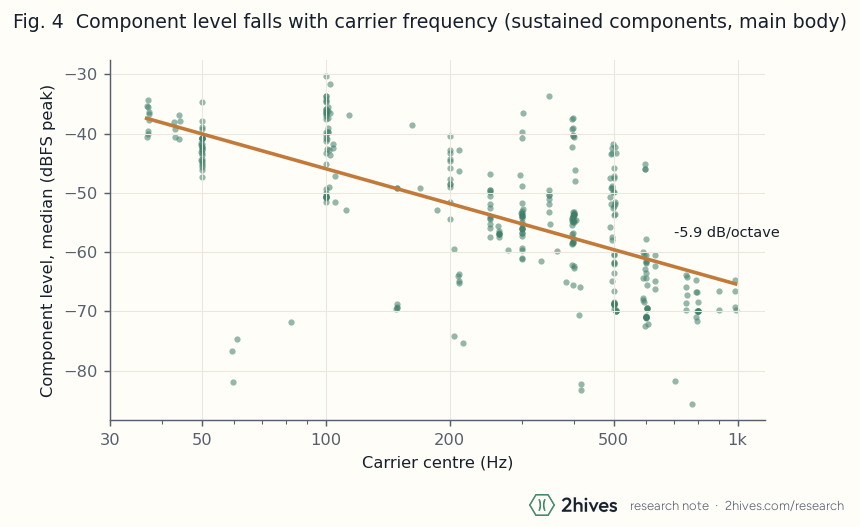
Tone level changes by -4 dB per octave of carrier, so the higher tones sit quieter.
9 sessions end with a beta-range wake-up block.
Noise bed: brown, independent in each ear. Its level and brightness move on a slow 10-second cycle.
Tuning and carriers
Each session is built on one tone and its octaves; only the carriers change from session to session, the beats stay the same.
Solfeggio Journey 1 · Low Ground: tuned to 174 Hz, carriers 87, 174, 696 Hz.
Solfeggio Journey 2 · Warm Air: tuned to 285 Hz, carriers 71.25, 285, 570 Hz.
Solfeggio Journey 3 · Open Room: tuned to 396 Hz, carriers 99, 396, 500 Hz.
Solfeggio Journey 4 · Bright Step: tuned to 417 Hz, carriers 104.25, 417, 500 Hz.
Solfeggio Journey 5 · Middle Light: tuned to 528 Hz, carriers 132, 264, 528 Hz.
Solfeggio Journey 6 · Wide Water: tuned to 639 Hz, carriers 79.88, 159.75, 639 Hz.
Solfeggio Journey 7 · High Thread: tuned to 741 Hz, carriers 92.62, 185.25, 500, 741 Hz.
Solfeggio Journey 8 · Clear Bell: tuned to 852 Hz, carriers 106.5, 213, 500, 852 Hz.
Solfeggio Journey 9 · Far Light: tuned to 963 Hz, carriers 120.38, 240.75, 481.5, 963 Hz.
The sessions use the layered binaural method described in our research note. We measured a reference set of guided programs and generate every bed from those statistics, never from a recording.
Carrier–beat ordering: slow beats ride on low carriers and faster beats on higher ones, and each tone's level falls with carrier frequency (stacking and level).
Each phase moves the stack to a new band and crossfades smoothly into it (beats by stage).
A noise bed shaped to the measured spectrum keeps the tones soft and masks small sounds around you (noise).
The voice sits about 12 dB above the bed, and gentle mastering leaves the stereo beats intact (how your audio is made).
Beat frequency against carrier frequency in the reference set.Tone level against carrier frequency in the reference set.
Listening Note — After each session, one honest word for how the tone felt to you.
Questions
We'd like to use cookies from Google, Meta, Reddit, Microsoft, Quora, Spotify to measure our ads and see how the site is used. Nothing is set until you accept. Strictly necessary cookies are always on. Settings
Install 2hivesOpen your sessions like an app and control them from the lock screen.