Guided binaural sessions written around you. Start with 5 free hours. For new accounts · valid 14 days · terms
Research
2hives is built on published research and our own measurements, and we share both openly. This page collects the sources, our research note and an explanation of how your audio is generated.
Our research note
Layered binaural-beat programmes: structure measured in a reference set and a reproducible synthesis method · 2hives research note, October 2026
The note describes the acoustic structure of layered binaural-beat programmes (carriers, beat frequencies, levels, noise and timing) and a synthesis engine we built and validated.
Key findings:
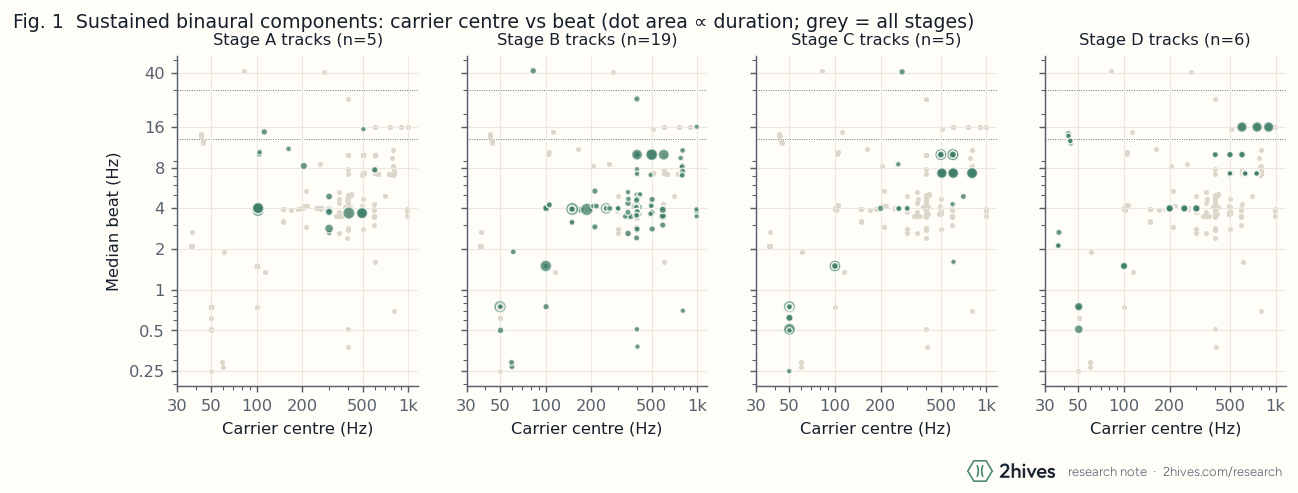
- Stacked beats: programs stack several tone pairs at once, up to 13.
- Carrier ordering: slower beats sit on lower carriers. About 0.5 Hz rides on 50 Hz, 1.5 Hz on 100 Hz, 4 Hz on 200–400 Hz and 10 Hz on 500–800 Hz.
- Level hierarchy: tone level falls about 6 dB per octave of carrier.
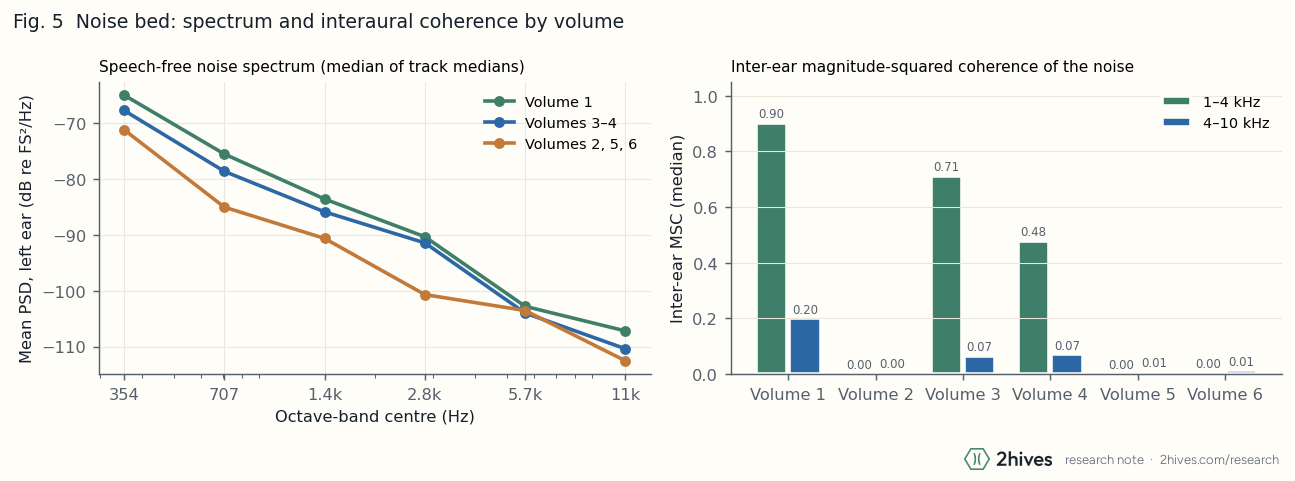
- Noise bed: a soft brown–pink bed with a slow 10-second cycle.
- Validation: re-measured with the same tool, our engine's test renders recovered 55 of 64 measured tone components, with beat errors at or below 0.02 Hz.
How your audio is made
- A journey template sets the arc: phases such as arrive, descend, deep rest and return, each with its own stack of tone pairs. These are drawn from the measured statistics, never copied from any recording.
- Your prompt shapes the words and the sound: imagery, tone, your name, voice, length, depth, ambience. An AI writes the script within safety rules, and you can listen line by line before you keep it.
- The tone bed is synthesised sample by sample. Several detuned sine pairs per phase are crossfaded smoothly, with slow frequency glides. Underneath is a noise bed shaped to a measured spectrum, independent in each ear.
- The voice is a licensed synthetic voice, paced like a calm guide: slower in deep phases, with natural pauses and a gentle fall at the end of each line. It sits about 15 dB above the bed overall, and more in the speech band: see How the sound is made.
- Mastering is gentle (−28 LUFS), with nothing that would smear the stereo beats. Every render ships with a spec sheet: an academic-style description of exactly what's in your file, verified by analysing the file itself.
See it measured: How the sound is made has charts from our own renders and four short clips that let you hear the noise, the moving filter, the tones and the voice one layer at a time.
The evidence, honestly
- Binaural beats are real: two slightly different tones, one per ear, create a perceived beat in the brainstem (Oster, 1973).
- Whether they "entrain" brainwaves is unclear. A 2023 systematic review found 5 of 14 EEG studies consistent with entrainment, 8 contradicting it and 1 mixed (Ingendoh et al., 2023).
- Results vary. A 2019 meta-analysis found a medium overall effect on the outcomes it pooled, stronger when listening came before a task; the studies varied widely (Garcia-Argibay et al., 2019).
- Context matters too. Relaxation, guidance and expectation all contribute to the experience.
2hives programs are for relaxation, meditation and self-exploration. They aren't medical treatment. See our Disclaimer.
Frequencies: tunings, Solfeggio tones and 40 Hz
What the research says about frequencies: mostly small studies, some interesting, nothing proven. We offer these as tunings and colours you can choose, so you can pick the sound you like.
- How we use them. The beat pattern of a session is its design; the carrier tones are its colour. The Tuning setting in the editor re-pitches only the carriers, so every beat stays exactly as designed, and each session's science page lists the carriers it uses.
- A=432 Hz tuning lowers every pitch by 31.8 cents, about a third of a semitone; most listeners cannot tell which is which. Small pilot studies compared music at 432 and 440 Hz: in 33 volunteers, heart rate was about 5 beats per minute lower at 432 Hz, at the edge of statistical significance (Calamassi & Pomponi, 2019); a crossover study in 43 patients found a similar small difference (Hohneck et al., 2025). Many listeners simply prefer its warmer feel.
- The nine Solfeggio tones (174, 285, 396, 417, 528, 639, 741, 852 and 963 Hz) are a modern meditation-music convention. The names borrow from medieval solmization (ut, re, mi, from the hymn Ut queant laxis), which had no fixed pitches; the frequencies were popularised by Joseph Puleo and Leonard Horowitz in the 1990s. We found no controlled study of the set. One study of 528 Hz music in nine people, five minutes each, reported small changes in saliva measures, and its authors state that the claims made for these tones have no scientific basis (Akimoto et al., 2018). Many listeners call 528 Hz the love tone; that is a cultural tradition, not a scientific finding. Above about 700 Hz a binaural beat fades, so in our sessions 741, 852 and 963 Hz sound as quiet colour tones over a lower pair.
- 40 Hz is a gamma rhythm studied in neuroscience labs. The brain reliably follows a sound pulsed 40 times a second in an EEG; whether that helps anyone is the open question. Flickering light and clicks at 40 Hz changed brain tissue in mice (Iaccarino et al., 2016; Martorell et al., 2019); a small pilot in patients found it safe, with no difference on standard thinking tests (Chan et al., 2022). Studies of 40 Hz binaural beats are mixed: one double-blind study of 30 people found no change in memory scores or EEG (Borges et al., 2023). Our 40 Hz Focus session uses a pulsed tone as a focus soundscape, not a treatment.
- Safety. Pulsing sounds: stop if you feel unwell. Do not use the 40 Hz session if you have epilepsy or a history of seizures.
References: Calamassi D, Pomponi GP (2019), Explore 15(4):283–290. Hohneck A et al. (2025), BMC Complementary Medicine and Therapies. Akimoto K et al. (2018), Health 10(9). Iaccarino HF et al. (2016), Nature 540:230–235. Martorell AJ et al. (2019), Cell 177:256–271. Chan D et al. (2022), PLOS ONE 17(12):e0278412. Borges LR et al. (2023), Healthcare 11(6):801. Garcia-Argibay M et al. (2019), Psychological Research 83:357–372.
Library
Papers we're allowed to share are hosted here. Others link to their publisher.
Patents and reports (public domain)
- Monroe, R. A. (1975). Method of inducing and maintaining various stages of sleep in the human being. US Patent 3,884,218. PDF
- Monroe, R. A. (1993). Method of inducing mental, emotional and physical states of consciousness… US Patent 5,213,562. PDF
- Monroe, R. A. (1994). Method of and apparatus for inducing desired states of consciousness. US Patent 5,356,368. PDF
- McDonnell, W. M. (1983). Analysis and Assessment of Gateway Process. US Army; declassified CIA document. PDF
Open-access research (CC BY, shared with attribution)
- Ingendoh, Posny & Heine (2023). Binaural beats to entrain the brain? A systematic review. PLOS ONE. PDF
- A new perspective on binaural beats (2024). PLOS ONE. PDF
- McConnell et al. (2014). Theta binaural beats and the autonomic nervous system. Frontiers in Psychology. PDF
- Chaieb et al. (2015). Auditory beat stimulation and its effects on cognition and mood states. Frontiers in Psychiatry. PDF
- Orozco Perez, Dumas & Lehmann (2020). Binaural beats through the auditory pathway. eNeuro. PDF
Linked (copyright with the publisher)
- Oster, G. (1973). Auditory beats in the brain. Scientific American 229(4).
- Atwater, F. H. (1997). Accessing anomalous states of consciousness with a binaural beat technology. Journal of Scientific Exploration 11(3). Publisher
- Garcia-Argibay, Santed & Reales (2019). Efficacy of binaural auditory beats in cognition, anxiety, and pain perception: a meta-analysis. Psychological Research 83. Publisher
2hives is independent and not affiliated with Monroe Products or The Monroe Institute. Names are used only to refer factually to published works.